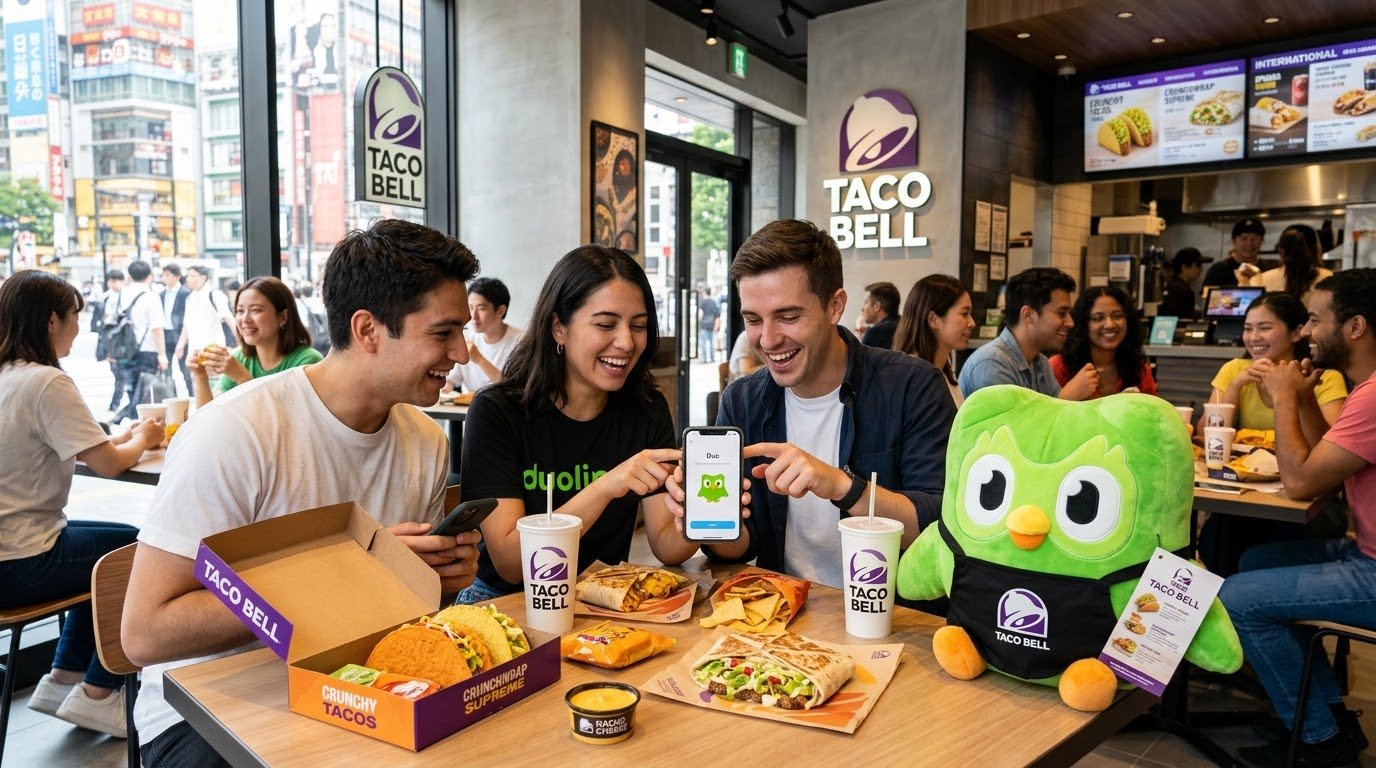
Taco Bell and Duolingo brought two recognizable brands together for a global marketing campaign built around one familiar word: “taco.” Announced on October 1, 2026, the collaboration turned Taco Bell’s annual National Taco Day celebration into Global Taco Day on October 6, combining limited-edition products, language-learning promotions, collectible merchandise, and in-person experiences.
The Taco Bell Duolingo marketing campaign offers an interesting example of how brands can work together to reach audiences beyond their usual markets. Rather than relying on a single advertisement, the partnership connected food, language, digital engagement, and real-world experiences through a shared cultural idea.
For marketers and business leaders, the campaign raises an important question: what makes a brand partnership memorable, and how can companies turn that attention into measurable business results?
What Was the Taco Bell and Duolingo Global Taco Day Campaign?
Global Taco Day was a collaboration between Taco Bell, the quick-service restaurant chain, and Duolingo, the language-learning platform known for its green owl mascot, Duo. The campaign celebrated the word “taco” as something recognizable across languages and cultures.
The activation took place on October 6, 2026, with promotional activity announced across the United States, Canada, Australia, China, India, Spain, and the United Kingdom. The companies combined limited-edition sauce packets, a Super Duolingo offer, co-branded merchandise, and selected in-person events.
The campaign was more than a product promotion. It connected Taco Bell’s food-focused identity with Duolingo’s language-learning personality, giving both brands a shared theme that could work across different markets.
For Taco Bell, the partnership offered another way to make a familiar food occasion more distinctive. For Duolingo, it created an opportunity to bring its language-learning identity into restaurants, packaging, and consumer experiences outside its app.
How the Taco Bell–Duolingo Partnership Worked
The campaign used several connected activities to make the collaboration visible in different places. Each element served a different purpose, from encouraging restaurant visits to creating social conversation and promoting language learning.
Duo Habanero Sauce and Multilingual Packaging
One of the campaign’s central features was the limited-edition Duo Habanero Sauce. The sauce packets included taco-themed sayings in nine languages: English, Spanish, French, Hindi, Portuguese, German, Korean, Mandarin, and Japanese.
This approach turned an ordinary restaurant item into a branded communication channel. Customers could encounter the partnership while ordering food, opening a sauce packet, or sharing the packaging with others.
The multilingual element also supported the campaign’s global message. Instead of simply translating a standard advertisement, the brands used language itself as part of the creative concept.
For marketers, the lesson is practical: products and packaging can contribute to a campaign when the message fits naturally into the customer experience. A small physical item can reinforce a larger brand idea without requiring customers to stop what they are doing to engage with an advertisement.
Taco Bell Rewards and Super Duolingo
The collaboration also connected Taco Bell’s loyalty program with Duolingo’s paid learning service. Eligible Taco Bell Rewards members could unlock one free month of Super Duolingo through an offer available from October 1 through October 6, 2026. Redemption was subject to the promotion’s terms, including a deadline for using the codes.
This offer linked two different forms of consumer engagement. Taco Bell Rewards connects customers with restaurant promotions, while Super Duolingo provides additional features for language learners.
The partnership gave each brand a reason to introduce its audience to the other. However, an offer being available does not automatically prove that customers redeemed it or continued using the service afterward. Those outcomes require separate measurement.
This is an important distinction for companies planning a cross-brand marketing campaign: offer availability is an activity, while redemption and lasting customer behavior are results.
Limited-Edition Merchandise and Live Experiences
The partnership included limited-edition co-branded Duo plushies, with 1,000 announced globally, alongside selected local activations. In-person campaign activities were announced for New York City, Toronto, Mumbai, and Shanghai.
These experiences extended the collaboration beyond restaurant packaging and digital promotions. Limited-edition merchandise can encourage people to discuss a campaign, while live activations can make the partnership more tangible for customers who attend.
Such tactics can support social sharing and earned media, but their actual impact depends on execution and audience response. The number of products produced or events held does not, by itself, establish how much additional awareness or revenue a campaign generated.
Why the Partnership Makes Marketing Sense
A successful brand partnership needs more than two well-known names. The companies should have a credible reason to work together, and the shared idea should make sense to the people they want to reach.
The Taco Bell and Duolingo collaboration connected food culture with language learning. Taco Bell brought a familiar restaurant experience, while Duolingo contributed a distinctive mascot and a clear connection to words, languages, and learning.
The word “taco” provided a simple bridge between the brands. It was easy to understand, suitable for multilingual creative work, and closely connected to Taco Bell’s products.
Connecting Digital Engagement With Physical Products
Many marketing campaigns operate primarily through digital advertisements, social media, or email. This collaboration also used a physical product to carry the message.
A sauce packet could introduce the campaign during a restaurant visit, while the Super Duolingo promotion connected the restaurant brand to a digital subscription. Merchandise and live events added further ways to encounter the partnership.
This creates multiple customer touchpoints. Someone might first hear about the campaign online, see the sauce in a restaurant, and later investigate the language-learning offer.
However, marketers should not assume that every customer will move through every stage. A campaign should be designed around a clear customer journey, with each activity supporting a defined objective.
Making a Global Idea Relevant Locally
Global marketing requires consistency without treating every market as identical. A message that works in one country may need different language, creative execution, offers, or operational arrangements elsewhere.
The campaign’s use of nine languages helped reinforce its international theme. Its announced markets included the United States and six other countries, while local promotions and packet details varied.
For businesses expanding internationally, this illustrates the importance of balancing a central brand concept with local execution. Companies should consider language, cultural context, availability, regulations, and customer expectations before launching a campaign across multiple markets.
What Marketers Can Learn From the Campaign
The Taco Bell global marketing strategy provides several useful considerations for businesses exploring cross-brand marketing campaign examples. These are lessons that can be drawn from the campaign’s design, rather than claims about its unverified performance.
1. Start With a Shared Idea, Not Just Two Famous Brands
The strongest collaborations give audiences a reason to understand why the brands belong together. A partnership based only on reach can feel forced if the products, personalities, or customer interests do not connect.
Before approaching a potential partner, businesses should ask whether both brands can contribute something meaningful to the same idea. They should also consider whether the partnership would make sense to existing customers.
2. Give Customers More Than One Way to Participate
The campaign combined restaurant products, loyalty rewards, a digital subscription offer, merchandise, and live experiences. These activities created different opportunities for customers to notice or engage with the collaboration.
Businesses can apply the same principle without copying the scale of the campaign. A smaller company might combine a co-branded product, a joint email promotion, and a limited event.
The right combination depends on budget, audience, distribution, and the desired outcome. More campaign elements are not automatically better if they complicate the customer experience or make results difficult to measure.
3. Make Localization Part of the Plan
Translation alone does not guarantee that a campaign will feel relevant in another market. Marketers should review the message, imagery, product availability, offer conditions, and cultural associations in each location.
A practical process includes local language review, market-specific offer checks, operational planning, and consistent brand guidelines. Businesses should also make clear which offers are available in which markets.
4. Measure Business Results, Not Just Attention
A campaign may generate conversation without creating enough incremental business to justify its cost. Marketing teams should decide what success means before launch and select metrics that match those objectives.
Useful measures may include:
- Campaign reach and engagement.
- Offer redemption and subscription conversions.
- Incremental restaurant visits or purchases.
- New loyalty memberships and repeat activity.
- Brand awareness and audience sentiment.
- Cost per acquisition and overall campaign profitability.
Not every metric applies to every partnership. A campaign focused on awareness may use different measures from one designed to drive immediate sales. Results should be compared with a relevant baseline or control where practical.
How to Measure a Cross-Brand Marketing Campaign
A useful measurement plan connects each campaign activity to a business objective. For example, a loyalty offer may aim to attract new customers, while a co-branded product may be designed to increase awareness and encourage social discussion.
| Campaign activity | Possible measurement |
|---|---|
| Limited-edition product | Units distributed, purchase patterns, and incremental sales |
| Loyalty promotion | Offer redemptions, new memberships, and repeat visits |
| Subscription offer | Activations, conversion rate, and post-promotion retention |
| Social campaign | Reach, engagement, shares, and sentiment |
| Live activation | Attendance, participation, qualified leads, and post-event actions |
| Global rollout | Market-level performance, localized engagement, and cost differences |
Where possible, businesses should use tracking links, unique offer codes, campaign-specific landing pages, and market-level reporting. These methods can help connect activity with customer actions, although they do not eliminate every attribution challenge.
Marketing teams should also compare the total cost of the collaboration with its outcomes. Costs may include creative production, product development, media spending, logistics, staffing, licensing, and partner fees.
The goal is not simply to report how many people saw a campaign. It is to understand whether the partnership contributed to the intended business outcome and whether the result justified the investment.
Potential Challenges of Global Brand Partnerships
Cross-brand marketing can create opportunities, but it also introduces risks. The first is brand fit. If customers cannot understand the connection between the partners, the campaign may generate confusion rather than interest.
Localization presents another challenge. Different markets may require separate translations, promotional terms, inventory plans, and distribution arrangements. A campaign that looks consistent in an announcement can still be difficult to execute uniformly across multiple countries.
There is also the question of measurement. When two brands contribute to a campaign, it can be difficult to determine which activity caused a customer to act. Strong tracking and agreed reporting responsibilities can reduce uncertainty.
Finally, limited-time promotions need clear conditions. Brands should communicate eligibility, availability, redemption deadlines, and local differences to avoid disappointing customers.
For smaller businesses, a successful partnership does not require an international rollout or a large merchandise budget. A carefully chosen partner, a clear shared message, and a measurable objective may be more valuable than a complex campaign with no defined success criteria.
For additional background on the company and its customer-facing initiatives, read our guide to Taco Bell marketing strategy. For broader planning ideas, businesses can also explore cross-brand marketing and customer loyalty approaches.
Final Thoughts
Taco Bell and Duolingo turned Global Taco Day into a multi-part campaign that connected food, language learning, loyalty rewards, merchandise, and live experiences. Its central idea was simple: use a familiar word to bring two different brand identities together across multiple markets.
The collaboration demonstrates how brands can extend a shared concept across physical and digital touchpoints. It also highlights the importance of choosing a credible partner, adapting execution for local audiences, and making participation straightforward.
The ultimate business value depends on results that must be measured, not assumed. For marketers, the most useful takeaway is to build partnerships around a clear shared idea, connect each activity to an objective, and evaluate the campaign using evidence rather than attention alone.
FAQs
What was the Taco Bell and Duolingo marketing campaign?
It was a collaboration for Global Taco Day on October 6, 2026. The campaign included limited-edition Duo Habanero Sauce, multilingual packaging, a Super Duolingo promotion, co-branded plushies, and selected in-person activations.
Why did Taco Bell partner with Duolingo?
The partnership connected Taco Bell’s food culture with Duolingo’s language-learning identity. The shared idea of the word “taco” provided a simple theme for a multilingual campaign that could be adapted across several markets.
What was Duo Habanero Sauce?
Duo Habanero Sauce was a limited-edition Taco Bell sauce created for the collaboration. Its packaging featured taco-themed sayings in nine languages, turning an everyday restaurant item into part of the campaign.
Which countries participated in Global Taco Day 2026?
The announced campaign covered the United States, Canada, Australia, China, India, Spain, and the United Kingdom. Offers and local execution varied by market.
What did Taco Bell Rewards members receive?
Eligible Taco Bell Rewards members could unlock one free month of Super Duolingo during the October 1–6, 2026 offer period. Redemption was subject to the promotion’s terms and deadlines.
What is cross-brand marketing?
Cross-brand marketing is a collaboration in which two or more brands work together to promote a product, service, event, or shared idea. It can help brands reach new audiences when the partnership is relevant to customers and benefits both participants.
How can companies measure the success of a brand collaboration?
Companies can track engagement, offer redemption, incremental purchases, new customers, repeat activity, brand awareness, and campaign costs. The right metrics depend on the campaign’s objectives, and results should be compared with an appropriate baseline whenever possible.
What can marketers learn from the Taco Bell and Duolingo campaign?
Marketers can learn to build partnerships around a shared idea, create multiple ways for customers to participate, adapt campaigns for different markets, and define measurable objectives before launch. They should not assume that attention automatically translates into sales or long-term customer value.