

Taco Bell Background Check Process: Everything Applicants Need to Know
Getting a conditional offer from Taco Bell is the exciting part. Then someone mentions the background check, and the questions start piling up fast. What exactly do they look for? How long is this going to take? And if there’s something on your record, does that automatically end things?
The honest answer is that the process is far more navigable than most people assume once you actually understand how it works. This guide covers everything: what the check includes, how the timeline plays out, what genuinely disqualifies people versus what doesn’t, your legal rights under federal law, and what to do if things don’t go as planned. Whether you’re applying for a crew member role in Texas, a manager position in California, or a shift at a location in the UK or Canada, this is the information you need before the check runs.
Does Taco Bell Do Background Checks?
Yes. Taco Bell conducts a background check on virtually all new hires full-time and part-time alike. The check is standard at corporate-owned locations and most franchise restaurants across the United States, Canada, and the UK. Critically, it happens after a conditional job offer is extended, not before your interview, which means you’ve already earned the offer before any screening begins.
The check itself is handled by a third-party Consumer Reporting Agency (CRA) the industry term for background check companies. Taco Bell and its franchise operators have used vendors including Checkr, Sterling, HireRight, and First Advantage, depending on the location. When you sign the authorization form, the vendor’s name appears on it. That’s the company whose report matters most if you ever need to follow up or dispute anything later.
What Does Taco Bell’s Background Check Actually Include?
The depth of the check depends on the role, but for most positions it covers the following:
Criminal history search — The core component. This typically includes county court records from your current and recent counties of residence, a statewide repository search, and a broad national criminal database sweep. For management and corporate roles, federal criminal records are also reviewed.
Identity verification via SSN trace — Your Social Security Number is cross-referenced with credit bureau data to confirm who you are and generate a list of addresses associated with your SSN. This also tells the provider which jurisdictions need to be searched for criminal records.
Sex offender registry — Checked through the National Sex Offender Public Website (NSOPW) for all positions. A registry listing is one of the most consistently disqualifying findings across every Taco Bell role.
Employment history verification — More commonly required for supervisory and management-level applicants than for crew positions. It verifies job titles, employment dates, and in some cases reason for leaving.
Education verification — Rarely required for entry-level or shift-leader positions. It applies primarily to district manager, area coach, and corporate roles where a specific degree or credential was listed on the application.
Credit history — Not standard for most restaurant roles. May apply to district managers, area coaches, and corporate finance positions that carry profit-and-loss responsibilities.
One question that comes up frequently: does Taco Bell check social media? Not as part of standard pre-employment screening. Some corporate-level hiring processes may informally review publicly available profiles, but it’s not a structured part of the background check itself.
The Taco Bell Background Check Process, Step by Step
Here’s the complete sequence from the moment you apply through to your first day:
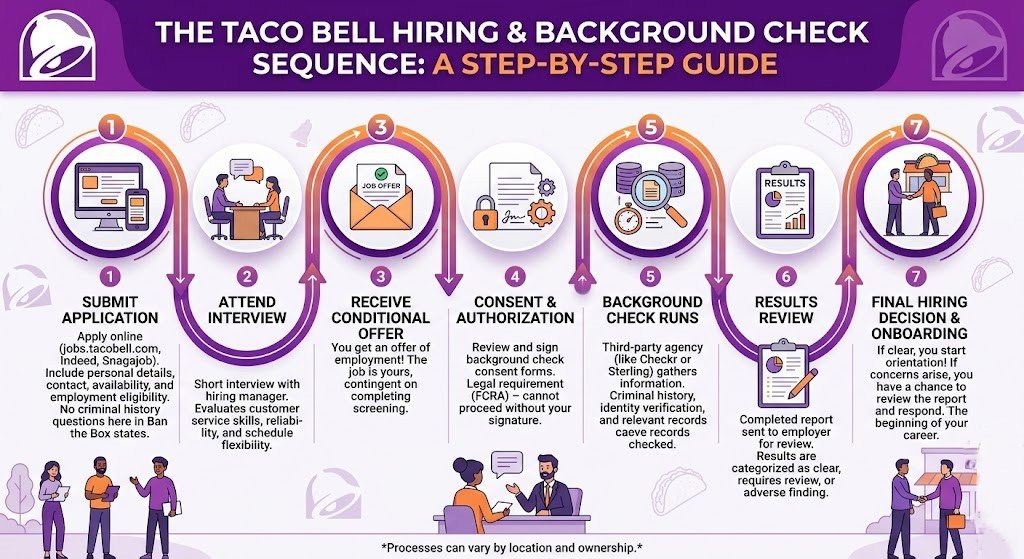
1. Application — You submit online through jobs.tacobell.com or a platform like Indeed or Snagajob. In most states with Ban the Box laws, criminal history isn’t asked about at this stage.
2. Interview — A brief interview with the hiring manager or a senior shift leader. Questions typically focus on availability, prior experience, and whether you can handle a fast-paced environment.
3. Conditional Job Offer — If the interview goes well, you receive an offer. The word “conditional” is important here — the job is genuinely yours, pending the result of the background check. This is a real offer with real terms, not a placeholder.
4. Disclosure and Authorization — Before anything is checked, Taco Bell must provide you with a written disclosure explaining that a background check will be conducted. You then sign a separate authorization form. This is a legal requirement under the Fair Credit Reporting Act (FCRA) the check cannot legally proceed without your signature.
5. The Check Runs — Once authorization is received, the CRA begins searching criminal records across the relevant jurisdictions, verifying identity, and completing any role-specific checks.
6. Results Reviewed — The completed report is delivered to the hiring manager or HR coordinator. Results are typically categorized as clear, requires further review, or adverse finding.
7. Final Decision — If the result is clear, onboarding begins. If a concern is flagged, federal law requires a specific process before any denial can be finalized which is explained in the FCRA rights section below.
How Long Does the Taco Bell Background Check Take?
Most checks are completed within 3 to 7 business days. From signing your authorization to receiving a hiring decision, the realistic total window is 5 to 10 business days in most cases.
Several things can push that timeline longer:
- Court backlogs — Some county courthouses still rely on in-person or manual record searches, which add time regardless of how quickly the CRA acts.
- Multiple states of residence — More jurisdictions mean more searches, and each one adds potential processing time.
- Common names — When a name is shared by multiple people, the CRA may require manual verification before attaching records to your report.
- Incomplete information — Any error in the details you provided, including a misspelled name or transposed address, can pause the process until it’s corrected.
Here’s what matters most: a delay is not a denial. These two things have no relationship to each other. If you haven’t heard anything after 10 business days, follow up directly with your hiring contact. You can also contact the CRA using the information on your authorization form to get a status update.
What Actually Disqualifies You from Working at Taco Bell?
This is where most people want specifics, and the honest answer is more nuanced than a simple list.
Records that almost always disqualify:
- Sexual offenses and sex offender registry listings
- Violent felonies assault, robbery, homicide
- Crimes involving minors or children
- Recent drug trafficking or distribution charges
- Terrorism-related offenses
Records reviewed case-by-case:
- Non-violent felonies, particularly those more than 5 to 7 years old
- Theft or fraud charges more scrutinized for cash-handling roles
- DUI or DWI a single older DUI is unlikely to block a standard floor role; multiple or recent DUIs raise more concern; any DUI may be disqualifying for roles involving driving
- Older drug possession charges
Records that typically do not disqualify:
- Arrests that never resulted in conviction
- Minor or isolated misdemeanors, especially old ones
- Expunged or sealed records legally protected and generally not reportable
- Older marijuana convictions, which carry decreasing weight in states where recreational use is now legal
The reason this is case-by-case rather than automatic is tied to EEOC guidance. The Equal Employment Opportunity Commission has consistently warned against blanket criminal record exclusion policies, and employers are expected to conduct an individualized assessment that weighs the nature of the offense, how much time has passed, and how directly the offense relates to the specific job. A decade-old non-violent felony and a recent violent crime are not treated the same way, and shouldn’t be.
Background Check Standards Vary by Position
What Taco Bell scrutinizes and how closely shifts depending on the role you’re pursuing.
| Role | Criminal Check | Employment Verification | Credit Check |
|---|---|---|---|
| Crew Member / Team Member | Standard | Usually not required | No |
| Shift Leader | Standard | Often required | No |
| Restaurant General Manager | Full, including federal | Required | Sometimes |
| Area Coach / District Manager | Comprehensive | Full history | Yes |
| Corporate Roles | Most extensive | Full + references | Yes |
For the majority of people reading this guide those applying for crew or shift-level positions the check is streamlined and focused primarily on criminal history and identity. The threshold for disqualification is also more lenient than for management, particularly around financial crimes.
Corporate Taco Bell vs. Franchise Locations: A Key Difference
Roughly 93% of Taco Bell restaurants are franchise-operated, owned and run by independent business operators rather than Yum! Brands directly. This has a direct impact on how background checks play out in practice.
Corporate-owned locations follow standardized HR procedures set at the Yum! Brands level. The process is consistent, well-documented, and follows a defined adverse action procedure.
Franchise locations operate with more flexibility. Different operators may use different CRA vendors, apply different levels of scrutiny to the same record types, or have different internal standards entirely. What disqualifies you at one Taco Bell franchise location may not disqualify you at another, even in the same city.
This also means that being declined at one location does not close the door everywhere. If you receive an adverse decision from a franchise operator, it’s worth exploring other Taco Bell locations in your area particularly if there’s a mix of corporate and franchise stores nearby.
State Laws That Shape Your Background Check Experience
Where you apply significantly affects what Taco Bell can legally consider, and in many states the law provides applicants with protections that go well beyond the federal baseline.
Ban the Box laws prohibit employers from asking about criminal history on the initial job application, pushing that inquiry to later in the process. States with these protections for private employers include California, Colorado, Connecticut, Hawaii, Illinois, Maryland, Massachusetts, Minnesota, New Jersey, New Mexico, Oregon, Rhode Island, Vermont, and Washington State. Cities including New York City, Chicago, Philadelphia, Los Angeles, and Seattle have their own local versions that often go further.
California applicants receive some of the strongest protections in the country. Under AB 1008 California’s Fair Chance Act Taco Bell cannot ask about criminal history until after a conditional offer is made. Before declining anyone based on a record, the employer must conduct a written individualized assessment and give the applicant a chance to respond. The standard criminal history lookback period under California law is seven years. The state’s ICRAA also imposes additional disclosure requirements around how background check information is gathered and used.
New York City applicants are protected under the NYC Fair Chance Act, which requires a multi-factor Article 23-A analysis before a criminal record can be used to deny employment, and gives applicants at least three business days to respond to any concerns before a final decision is made.
In states like Texas and Florida, fewer statutory restrictions apply, and franchise operators in those markets generally have broader discretion in how they evaluate records. That said, EEOC guidance against blanket exclusion policies still applies nationally, regardless of state.
Your Rights Under the Fair Credit Reporting Act
The FCRA is the federal law that governs how background checks can be used in hiring. It applies to every Taco Bell location across the United States corporate or franchise and understanding it gives you real leverage if anything goes wrong.
Disclosure and authorization. Before the check begins, Taco Bell must provide a standalone written disclosure not buried in a broader contract and obtain your signed consent. Running a background check without this is a federal violation.
The pre-adverse action notice. If Taco Bell intends to deny employment based on your background check, they must first send you a pre-adverse action notice that includes a full copy of your report and the FTC’s summary of FCRA rights. You then have a reasonable window generally at least five business days to review the findings and respond before any final decision is made.
This window is often overlooked, but it’s genuinely valuable. It’s your opportunity to dispute inaccurate information, provide documentation of an expungement that wasn’t reflected correctly, or offer context around what’s on the record. Many candidates don’t realize this step exists and miss their chance entirely.
The adverse action notice. If the employer proceeds with a denial, a final adverse action notice must identify the CRA that provided the report, confirm that the CRA did not make the employment decision, and outline your right to a free copy of the report within 60 days and your right to dispute its accuracy.
Disputing errors. If your report contains information that’s wrong mistaken identity, records that belong to someone with a similar name, or a conviction that was expunged and shouldn’t be appearing you can dispute it directly with the CRA in writing. The CRA must investigate and respond within 30 days, and if the dispute resolves in your favor before a final employment decision is made, the corrected report should be taken into account.
For a detailed walkthrough of how to file a dispute and what to expect, read our guide on [How to Dispute a Background Check Error].
How to Prepare Before the Check Is Initiated
A small amount of preparation before signing the authorization form can meaningfully improve your outcome.
Run your own background check first. Services like Checkr’s personal reports, your state court’s online search portal, and PACER.gov for federal records will show you what’s likely to appear. This lets you spot unexpected records, errors, or cases where another person’s record has been attached to your identifying information.
Have your documents ready. Your full legal name, any former names you’ve used, Social Security Number, date of birth, and a complete address history for the past 7 to 10 years are the core requirements. For management applications, have accurate employment dates and supervisor contact information ready for at least your two or three most recent employers.
Be honest on your application. The most common reason passable candidates are rejected is not the record itself it’s a discrepancy between what was written on the application and what the background check found. Employers consistently respond better to upfront honesty than to discovering an inconsistency after the fact.
Document any expungements. If a record was expunged or sealed, collect your court documentation. Expunged records occasionally appear in error on background check reports. Having the paperwork ready means you can dispute quickly if needed.
Applying to Taco Bell with a Criminal Record
Having a prior record does not automatically end your chances. Taco Bell has engaged with fair chance hiring initiatives, and the quick-service restaurant industry as a whole tends to be more accessible to applicants with records than sectors like finance or healthcare.
The three variables that matter most are the type of offense, how recently it occurred, and the role you’re applying for. A non-violent felony from several years ago is unlikely to disqualify you from a crew position. A recent violent offense or any sexual offense will almost certainly disqualify you regardless of role.
If your record is something that’s likely to appear, consider addressing it proactively once a conditional offer is on the table. You don’t need to volunteer information before you’re asked but once the offer is made and the check is about to run, a brief honest statement tends to land well. Something like: “The check will show a [type of record] from [year]. I’m happy to discuss it.” In states that require individualized assessment, you’ll have a formal opportunity to provide this context during the pre-adverse action period anyway.
If you were denied at one location, review your report carefully. Dispute anything inaccurate. Request reconsideration if your state’s laws support it. And remember that a different franchise operator may reach a different conclusion about the same record.
Drug Testing at Taco Bell (A Separate Process)
The background check and drug test are two distinct things, though they often run in parallel during pre-employment screening.
For most crew and shift-level positions, drug testing is not universal. Some franchise operators do conduct pre-employment drug screens, but it’s far from standard across all Taco Bell locations at the hourly level.
For managers and above, drug testing is more common. It may include pre-employment urinalysis, random testing during employment, and post-incident testing. The standard screen is a 5-panel test covering marijuana, cocaine, amphetamines, opiates, and PCP.
On the marijuana question specifically: in states where recreational use is legal, many franchise operators have moved away from THC testing for entry-level roles. This isn’t universal, and the safest approach is to confirm with the specific location if it’s a concern.
A failed drug test does not automatically affect the background check result, and vice versa. They’re handled through separate processes by different parties.
For the complete picture on Taco Bell’s screening policies, read our guide on [Taco Bell Drug Test Policy: What to Know Before You Apply].
Applying at Taco Bell in Canada
Taco Bell Canada is fully franchised, with individual operators managing their own hiring decisions. Background checks in Canada operate under a different legal framework than the US.
At the federal level, the Personal Information Protection and Electronic Documents Act (PIPEDA) governs how personal information including background check data can be collected and used. Provincial human rights codes provide additional protections that often go further.
The most important practical difference for Canadian applicants: if you have a criminal record for which a record suspension (formerly called a pardon) has been granted, that record cannot legally be used in hiring decisions. Ontario’s Human Rights Code explicitly prohibits discrimination based on a record of offences where a pardon or record suspension applies. British Columbia has similar protections, and Quebec’s Law 25 adds stricter requirements around data consent for how information is collected.
Common background check vendors used by Canadian employers include BackCheck, Triton, and Mintz Global Screening.
Applying at Taco Bell in the UK
Taco Bell UK is actively expanding under a franchise model across England. The background check framework here is fundamentally different from North American standards.
The standard pre-employment criminal record check in the UK is the Basic DBS check, administered through the Disclosure and Barring Service. For food service roles like Taco Bell, this is the typical level applied and it only reveals unspent convictions. Under the Rehabilitation of Offenders Act 1974, spent convictions do not need to be disclosed and will not appear in a Basic DBS report.
If your conviction is considered spent under UK law, you are not required to tell Taco Bell UK about it, and it won’t come up in the standard check. Whether a conviction is spent depends on the sentence you received and how much time has elapsed.
UK background check processing is regulated under UK GDPR and the Data Protection Act 2018, with the Information Commissioner’s Office (ICO) as the oversight body. If you’re unsure whether your conviction is spent and want guidance, the charity Unlock provides free information specifically on UK rehabilitation periods and disclosure rules.
How Taco Bell Compares to Other Fast Food Chains
If you’re weighing multiple applications and background check policies are part of your decision, here’s a straightforward comparison:
| Brand | Background Check | Felony Policy |
|---|---|---|
| Taco Bell | Yes | Case-by-case |
| McDonald’s | Yes | Case-by-case |
| Burger King | Yes | Generally lenient |
| Wendy’s | Yes | Case-by-case |
| Chick-fil-A | Yes | Stricter than average |
| Starbucks | Yes | Known fair chance approach |
| Subway | Yes | Generally lenient |
Taco Bell sits in the middle of the fast food industry not among the strictest, and generally considered accessible for applicants with records who approach the process honestly and understand their rights. For a full employer-by-employer breakdown across the industry, read our guide on [Fast Food Background Check Comparison: All Major Chains].
Final Thoughts
The Taco Bell background check process is structured and consistent and understanding it removes most of the anxiety that tends to build up around it. For the majority of applicants, including many with prior records, the outcome depends far more on preparation and honesty than on what happened years ago.
Know what’s on your record before the check runs. Be straight forward if anything is likely to appear. Understand your FCRA rights, especially the pre-adverse action window, because that’s a genuine opportunity most applicants don’t know they have. And if one location doesn’t work out, remember that the franchise model means the same conclusion isn’t guaranteed across every Taco Bell.
The process exists to protect both sides. Going in prepared puts you in the strongest possible position to make it work.
FAQs
Does Taco Bell do background checks for all employees?
Yes. Both full-time and part-time new hires go through a background check. The scope and depth vary by position, but the process applies across the board.
How far back does Taco Bell’s background check go?
Typically 7 to 10 years for most criminal records, depending on the state. California limits most reporting to 7 years. Federal records can extend further for management and corporate roles.
Can you work at Taco Bell with a felony?
Possibly. Non-violent felonies particularly older ones are often approvable, especially for crew-level positions. Violent crimes, sexual offenses, and recent serious felonies are generally disqualifying. The evaluation is case-by-case.
What happens if my Taco Bell background check is taking too long?
A delay has no connection to the outcome. Follow up with your hiring contact after 7 to 10 business days, or contact the CRA directly using the information on your authorization form.
What is a pre-adverse action notice, and what should I do if I receive one?
It’s a legal notice sent before Taco Bell can deny employment based on your background check. It includes your full report and gives you time to review and respond. Read the report carefully, dispute any inaccuracies with the CRA in writing, and provide any relevant context to the hiring manager within the window given.
Can you work at Taco Bell with a misdemeanor?
Usually yes. Minor misdemeanors, especially older ones, are unlikely to disqualify crew-level applicants. Misdemeanors involving theft, violence, or dishonesty receive more scrutiny, particularly for roles involving cash handling or supervision.
Does Taco Bell drug test at hiring?
Not universally. Drug testing for entry-level positions varies by franchise operator and is far from standard at every location. It becomes more common for shift leaders, managers, and above.
Does Taco Bell call previous employers?
Employment verification is typically required for supervisory and management roles, not for standard crew positions. Where it is conducted, it verifies job titles, dates of employment, and sometimes eligibility for rehire.
Can I dispute a Taco Bell background check result?
Yes. You have the right under the FCRA to dispute inaccurate or outdated information directly with the Consumer Reporting Agency that produced the report. The dispute must be in writing with supporting documentation, and the CRA is required to investigate within 30 days.
Does a rejected background check at one Taco Bell affect other locations?
No. Because most locations are independently franchised, a background check decision at one does not transfer to others. Different operators may reach different conclusions about the same record.